|

|

|

|
|
Oakleaf A camouflage
|
Over-sized to be worn
over wool service trousers
|
Full thighs and seat for
freedom of movement
|
Storm flap, correct gray 22mm buttons |

|

|

|

|
|
Reversed to white
|
ankle ties
|
Like originals, these are
flat, dull white |
Many find wearing the
suspenders crossed to
be more comfortable
|

|

|

|

|
Correct buttons, pattern, and original
webbing used for ankle ties |
Rear details |
Pattern came from original oak
shelter quarters and the colors
from the mitten in this photo. |
The WWII rayon fabric
was reproduced exactly
|
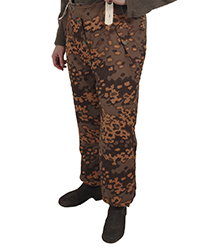
Reproduction WWII winter trousers, reversible from oakleaf A pattern camouflage to white, issued to troops of the Waffen SS. These are the 2nd pattern of Winterhose, made in 1944-45, with knee reinforcements and storm flap over the fly.
The shell fabric is 100% rayon which we had custom woven based on original samples as well as the specifications in the US Army's 1945-46 analysis of German camouflage, known as The Richardson Report. (Page 39 covers the rayon.)
Our camouflage print is identical to the original- spot for spot, same size repeat, no added artwork and color matched to WWII examples and printed with reactive dyes.
Unfortunately, we were not able to duplicate the crappy printing quality which give originals a coarser look.
The white side was printed dull, flat white- not bright bleached white. These look and feel like originals.
Water Repellent: Both sides of these uniforms are treated with Teflon fabric protector. This is the best quality DWR (Durable Water Repellent) available and is superior to the Peristol used on originals. It is completely invisible and does not affect the feel of the fabric in any way- aside from making it feel slightly smoother than untreated cloth. It's also PFOA free.
The insulation we used the heaviest polar fleece made- which weighs and feels the same as the Reizwolle (recycled wool) lining of the originals- while also being warmer, less prone to shrinkage, and 1/2 the cost.
For our ankle ties we used original gray webbing. The buttons are exact looking reproductions; 22mm gray on the camo side and the flat, knurled 4 hole types peculiar to SS winter trousers. Sadly, both are plastic- we weren't able to get ceramic or pressed cotton buttons made. As usual, the pattern of the trousers came from originals- these have all the proper details including waist tie, overlapping fly with storm flap, detachable suspenders, 26mm button holes, pocket flaps- all sewn with charcoal gray thread.
Effectiveness: We do not heave technical data such as R or CLO values on any of our garments. However, these have been test driven in Alaska, Canada, Wisconsin and other northern climes, down to well below zero. All feedback has been "warm as hell."
Washing: The best option is to hand wash these in cold water. Shrinkage will be about 2" in the sleeve length and 3" for the body. They take about 24 hours to dry when hung over a boot dryer.
We do not recommend using a clothes dryer! We tested this and it increases the shrinkage and it seems to cause the insulation to shift inside. However, the insulation will eventually settle back into place with continued wear.
Imported
Sizing Notes:
1. We copied the original sizing system exactly. The Germans designed these to be worn over several layers of clothing, and thus they are already oversized to allow for this!
2. These are designed to be worn higher than most trousers in order to insulate the body. The top will ride above the navel. If you have a large belly, measure around your middle rather than using your trouser waist size.
3. All inseams are 28". (Same as originals.)
The weak point-
There is one inherent design flaw on these trousers- the attachment point for the suspenders. On nearly all well used originals, one finds resewn buttons and plugs of material missing where the tension from the suspenders ripped the buttons out. The 1944 pattern Heer trousers finally addressed this with belt loops and suspenders being attached via wooden toggles reinforced with strips of extra fabric. I considered this option, but since this was only seen on late, non-reversible Heer trousers I opted not to.
We did add a band of thin webbing inside the waist behind the buttons (it's not visible) to reinforce the area. However, we recommend adding an extra set of buttons- one beside each of the existing ones- and hand sew them with heavy thread or cord. Speaking from personal experience, having a spares in place can make a potentially supremely aggravating experience into non-event. What type of buttons? One can find just about anything available in 1944 on originals....
Sizing Notes:
1. We copied the original sizing system exactly. The Germans designed these to be worn over several layers of clothing, and thus they are already oversized to allow for this!
2. These are designed to be worn higher than most trousers in order to insulate the body. The top will ride above the navel. If you have a large belly, measure around your middle rather than using your trouser waist size. Therefore, if you wear size 38 in jeans, but your belly is 44" around, get size IV's.
3. When trying them on, wear all the garments underneath you intend to wear these with. If you think they are too big, first squat, lie down and get up. You will see why the extra room is necessary to allow freedom of movement- and they may not be too big after all.
The Size Scale is:
Size I 30"-33" waist
Size II 34"-37" waist
Size III 38"-41" waist
Size IV 42"-46" waist
|
 SIGN IN
 SHOPPING BAG ()
 270.384.1965